
How many days does a TDS refund take
Usually 20 to 45 working days after you e-verify. What each CPC Bengaluru status means, what slows a refund down, and when a delay is worth chasing.
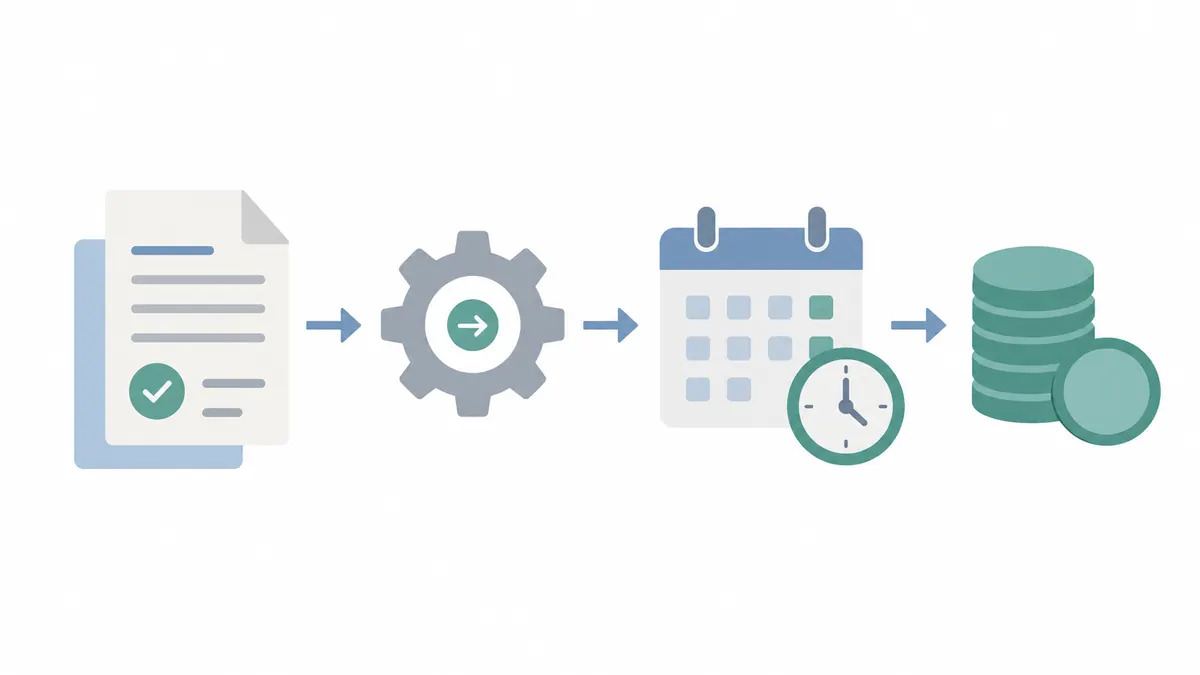
A TDS refund typically takes 20 to 45 working days (around 4 to 8 weeks) after you e-verify your Income Tax Return. Legally, the department can process returns until December 31st of the relevant assessment year.
On this page
- What you need before tracking your refund
- How CPC Bengaluru processes your refund status step by step
- 1. Submitted and Pending for e-Verification
- 2. Successfully e-Verified
- 3. Data Matching and Assessment
- 4. Processed
- 5. Refund Issued
- Why your TDS refund timeline varies
- What to do if your refund is delayed past 90 days
- What people get wrong about this
- 1. Thinking 45 days is a legal deadline for the department
- 2. Assuming physical ITR-V processing starts on your mailing date
- 3. Expecting money on the day status changes to “Processed”
- 4. Assuming a missing refund means the system forgot your return
Standard Income Tax Return (ITR) processing and TDS refund credit take between 20 to 45 working days after you e-verify your return. This works out to roughly 4 to 8 weeks, though the Income Tax Department is legally permitted to process returns up to 31st December of the relevant assessment year.
What you need before tracking your refund
Before you can expect your refund clock to start, you must complete your e-verification and verify your portal settings. The Income Tax Department does not process unverified returns, regardless of when you hit the submit button.
To ensure your return moves smoothly through the queue, check off these prerequisites:
- A valid e-verification method: Aadhaar OTP or net banking lets you verify instantly.
- A pre-validated bank account: Your bank account must be pre-validated on the e-filing portal and linked with your PAN.
- Matched tax records: Your declared TDS must match figures in Form 26AS, the Annual Information Statement (AIS), and the Taxpayer Information Summary (TIS).
- Your acknowledgment details: Keep your filing acknowledgment number handy to file grievances if delays happen later.
If you suspect high-value transactions or mismatched accounts might trigger scrutiny notices separately, review whether UPI and bank transfers can trigger a tax notice to understand how the department flags discrepancies.
How CPC Bengaluru processes your refund status step by step
The Centralised Processing Centre (CPC) in Bengaluru processes returns through an automated pipeline that checks data accuracy, sends formal intimations, and releases funds through banking channels. The entire procedure involves distinct automated stages, each reflected by a specific status message on your portal dashboard.
Filing & e-Verification
       │
       ▼
Automated Structural Checks ──(Fail)──► Defective Return Notice [Sec 139(9)]
       │ (Pass)
       ▼
Data Matching (26AS / AIS / TIS)
       │
       ▼
Intimation Generated [Sec 143(1)]
       │
       ▼
Status: "Processed"
       │
       ▼ (3-7 days)
Status: "Refund Issued"
       │
       ▼ (3-5 working days)
Credit in Bank Account (via SBI Refund Banker)
Here is what happens at each stage behind the scenes and what your portal status means:
1. Submitted and Pending for e-Verification
Processing has not started yet. You submitted your return, but you have not completed the verification step. If you post a physical signed ITR-V to Bengaluru instead of e-verifying, expect it to take 7 to 15 days just for the document to arrive and update on the system.
2. Successfully e-Verified
Your return has officially entered the queue at CPC Bengaluru. Automated systems run initial structural checks to confirm you used the correct ITR form for your profile and that your arithmetic matches. If structural errors exist, the system issues a defective return notice under Section 139(9).
3. Data Matching and Assessment
The automated system cross-checks your reported income, deductions, and TDS against records in Form 26AS, AIS, and TIS. Once the system finishes matching, it generates an intimation notice under Section 143(1) and emails it to your registered email address. This notice shows whether the department agrees with your refund claim, demands extra tax, or determines a nil outcome.
4. Processed
CPC has completed its assessment under Section 143(1) and determined your final refund amount. Your file moves to the refund release queue.
5. Refund Issued
The department has handed over your refund payout to SBI’s refund banker system. Once status updates to “Refund Issued”, the money typically credits to your pre-validated bank account within 3 to 5 working days.
Why your TDS refund timeline varies
ITR processing speed depends on your chosen form type, when you file, data accuracy, bank validation status, and whether your file is selected for audit. While simple returns often process within days during early months, peak seasonal backlogs and data discrepancies add considerable delays.
| Factor | Fast Processing (Days to Weeks) | Delayed Processing (Months) |
|---|---|---|
| ITR Form Used | ITR-1 or ITR-4 (Salaried / Presumptive) | ITR-2 or ITR-3 (Capital gains / Business income) |
| Filing Date | April, May, or June | July peak deadline rush |
| Data Alignment | Exact match with Form 26AS, AIS, and TIS | Discrepancies in interest, income, or TDS claims |
| Verification Method | Instant Aadhaar OTP or Net Banking | Physical ITR-V sent by mail |
| Bank Status | Account pre-validated and PAN linked | Unvalidated account or incorrect IFSC code |
| Audit Status | Standard processing | Selected for scrutiny under Section 143(2) |
Simple filings move fast. Returns filed on ITR-1 or ITR-4 move through automated checks quickly, sometimes processing within hours or days if filed early in the season. Complex forms like ITR-2 or ITR-3 involve multiple income heads or capital gains calculations, which require deeper verification.
Timing matters just as much. Returns filed during the July deadline rush join a massive backlog at CPC Bengaluru. Early filings in April or May bypass this queue. For context, during the AY 2025-26 cycle, the department received over 8.79 crore returns. By early February 2026, about 2.8 percent of those returns (around 24.6 lakh files) remained pending past three months due to backlogs, scrutiny, or data mismatches.
Finally, remember that under Section 245 of the Income Tax Act, the department can set off your current refund against unpaid tax demands from past years. You will receive a notification on the portal before an adjustment is finalized.
What to do if your refund is delayed past 90 days
If your status shows no progress for 60 to 90 days after e-verification, step through a systematic troubleshooting sequence. You should check your portal account details, inspect notices, and raise formal portal tickets before escalating to higher authority platforms.
Here is the step-by-step resolution path:
- Check your verification and bank status: Log in to the e-filing portal. Verify that your return status shows “Successfully e-Verified”. Go to your profile settings and ensure your bank account explicitly shows “Validated” with PAN details green-lit, not just “Added”.
- Review your intimations and pending actions: Open your email spam folder and check the “Pending Actions” tab on the portal. Look for any Section 143(1) intimation, Section 139(9) defective notice, or Section 245 notice of past tax adjustments.
- Submit a portal grievance: Go to e-File > Grievances on the portal. Select the relevant assessment year, pick CPC-ITR under the grievance category, and paste your filing acknowledgment number. Explain clearly that processing has exceeded standard windows.
- Send a direct email: Write to CPC Bengaluru directly at
helpdesk@cpc.incometax.gov.in. State your full name, PAN, assessment year, and acknowledgment number in the email body. - Escalate to higher platforms: If 15 to 30 days pass without a helpful response from portal grievances, submit an escalation through the Centralised Public Grievance Redress and Monitoring System (CPGRAMS) portal or contact the official Aaykar Sampark Kendra helpline. Keep written logs of every ticket number you generate.
What people get wrong about this
1. Thinking 45 days is a legal deadline for the department
The 20 to 45 working day window is an operational average, not a statutory mandate. By law, the Income Tax Department is allowed to process returns up to 31st December of the relevant assessment year. A return marked “Under Processing” two or three months after filing has not broken any legal timeline.
2. Assuming physical ITR-V processing starts on your mailing date
If you post a signed ITR-V paper form to Bengaluru, the 20-45 day processing window does not start on the day you drop the letter in the post box. It starts on the day CPC physically stamps and scans the document into their electronic queue, which usually adds 7 to 15 days to your total waiting time.
3. Expecting money on the day status changes to “Processed”
“Processed” means CPC has completed the calculation. It does not mean the transfer completed. The department takes 3 to 7 days from the processing date to hand over payout orders to the SBI refund banker system. After that transfer occurs, your bank requires another 3 to 5 working days to clear the funds into your account.
4. Assuming a missing refund means the system forgot your return
If your return status shifts to “Processed” but no money arrives, the department may have adjusted your refund against an old unpaid tax demand under Section 245. Check your portal notices to see if past dues wiped out or reduced your calculated refund. If that has happened, the Section 245 refund adjustment checker walks through your options. If the refund was approved but never reached your account, the refund bank validation checker covers the fix.
Common questions
How many days does it take to get a TDS refund?
A TDS refund typically takes 20 to 45 working days (around 4 to 8 weeks) after you e-verify your Income Tax Return. Legally, the department can process returns until December 31st of the relevant assessment year.
What must you do before your refund processing begins?
You must complete your e-verification, pre-validate your PAN-linked bank account on the portal, and ensure your declared TDS figures match Form 26AS, AIS, and TIS records.
Who processes TDS refund claims?
TDS refunds are processed by the Centralised Processing Centre (CPC) in Bengaluru through an automated system, which eventually credits funds through the SBI Refund Banker.
How long does it take for money to reach your account after the status shows Processed?
After your return is processed, the status changes to Refund Issued within 3 to 7 days, and the money credits to your bank account within another 3 to 5 working days.
Checked against Income Tax Department on 3 August 2026. Rules change, so confirm on the official portal before acting.
SimpleDoc is independent and not affiliated with any government body. This is general guidance, not financial or legal advice. Always confirm details on the official portal before acting.