
When can you take the driving test after a learner licence?
The 30-day minimum wait, the 180-day expiry, and what happens after you pass, including why you can drive before the smart card reaches you.
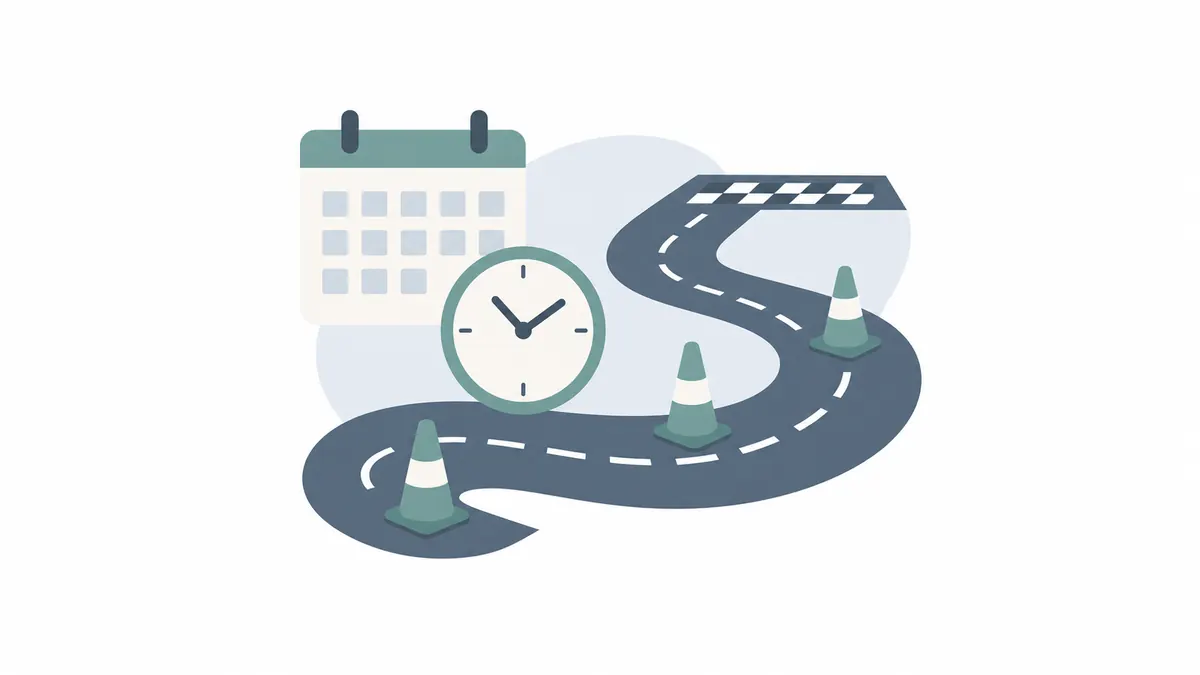
You can take the RTO driving test between 30 days and 180 days after your learner licence is issued. The law mandates a minimum 30-day waiting period to practice before taking the test.
On this page
You can take your RTO driving test at any time between 30 days and 180 days after your learner licence is issued. You cannot take the test before completing the mandatory 30-day wait period, and if you cross six months without passing the test, your learner licence expires completely.
Why the 30-day waiting period exists
Section 8 of the Motor Vehicles Act 1988 and Rule 15 of the Central Motor Vehicles Rules 1989 require a minimum 30-day gap between your learner licence and your permanent licence test. This period acts as a legal probation. It forces you to practice driving on public roads under supervision before taking the practical test.
The law treats a learner licence as temporary permission to practice, not a full entitlement to drive alone. Section 9 of the Act and Rule 3 of the Central Motor Vehicles Rules state that you can only drive if a person holding a valid permanent driving licence sits in the front passenger seat next to you. You must also display a red ‘L’ plate prominently on both the front and back of the vehicle. Traffic police can fine you if you drive without supervision or without these plates.
Thirty days is the statutory minimum before you can sit the permanent test. Six months (180 days) is the maximum before the learner licence expires. You do not have to appear on the 31st day if you feel unprepared. So you can use the extra weeks to practice parallel parking, hill starts, and track maneuvers. But if you let the full six months pass without passing the permanent test, you must start from scratch by filling out Form 2 again for a new learner licence.
How the process works from booking to the test track
Once your 30-day waiting period ends, you log into the Parivahan Sarathi portal using your learner licence number to submit Form 7. You select your vehicle category, upload any required documents, pay the state-specific test and smart-card fees, and book an available time slot at your local RTO track.
Booking a slot is entirely digital on sarathi.parivahan.gov.in. After logging in, click on ‘Apply for Driving Licence’. The portal auto-populates your personal details from your learner licence record. Verify these details, confirm your vehicle classes (such as LMV for cars or MCWG for geared motorcycles), and upload a fresh photograph if requested.
Fees and slot availability depend heavily on where you live. State transport departments set their own fee schedules for the test slot and the physical smart card, so there is no single number that holds nationally: check the exact fee breakdown on your own state’s Sarathi portal before paying. Urban RTOs often have slot waiting times of two to three weeks for popular vehicle classes, while smaller regional offices may offer slots within a few days or even accept walk-ins.
On test day, go to the RTO track with your vehicle, your physical learner licence printout, original identity proofs, and the slot booking receipt. An RTO examiner will evaluate your handling on a marked track. For car drivers, this usually involves driving an 8-figure track, reverse parking, and completing an uphill start without rolling backward. For motorcycle applicants, you must navigate a narrow track and an 8-figure layout without putting your foot on the ground.
What happens after you pass
Passing the test is not the end of the process, and this is where most people lose track of what is going on. The result is recorded on Sarathi first, then the licence is issued, then a smart card is printed and posted to you. Those are three separate steps and they do not happen together.
How long the card takes is set by your state and by whether it has print stock, so any single national figure you see quoted is somebody guessing. Track the actual position on the Sarathi section of the Parivahan portal using your application number or learner licence number. The status tells you which step it is sitting on, which is more useful than a number of days.
You do not have to wait for the card to drive. Once the licence has been issued it appears in DigiLocker and in mParivahan, and the Ministry of Road Transport and Highways has instructed enforcement authorities to treat a licence presented through either app as equivalent to the printed certificate. One condition matters: it has to be pulled live through the app. A photograph or a screenshot of the card is not the same thing and is not covered.
This is the single most useful thing to know at this stage, because the gap between passing and the card arriving is where people either avoid driving unnecessarily or drive with nothing to show.
Who this timeline applies to and who it does not
The 30-to-180 day timeline applies to all first-time applicants for private vehicle categories including LMV, MCWG, and MCWOG. It does not apply to commercial transport licence applicants, who must meet higher age thresholds and hold a non-transport LMV licence for at least one year before applying.
If you are 18 or older and applying for a private car (LMV) or a geared motorcycle (MCWG), you must follow the 30-day minimum wait rule. Sixteen-year-olds applying under Section 4 of the Motor Vehicles Act for an MCWOG licence (scooter up to 50 cc without gear) must also wait 30 days after getting their learner licence.
The rules change completely for commercial transport drivers. Under Section 4, you cannot get a transport licence (LMV-TR, HMV, or HGMV) merely by waiting 30 days after an initial learner test. You must be at least 20 years old and possess a valid non-transport LMV driving licence for at least one full year before you can apply for a commercial category learner licence.
| Licence Category | Vehicles Covered | Minimum Age | Prerequisite Experience | Test Timeline Rule |
|---|---|---|---|---|
| MCWOG | Scooter up to 50 cc | 16 years | None | 30 to 180 days after LL |
| MCWG | Geared motorcycle, any cc | 18 years | None | 30 to 180 days after LL |
| LMV (Non-Transport) | Private cars, vans up to 7,500 kg | 18 years | None | 30 to 180 days after LL |
| LMV-TR (Transport) | Taxis, light commercial vehicles | 20 years | 1 year holding LMV DL | Separate transport test process |
| HMV / HGMV | Heavy passenger or goods vehicles | 20 years | 1 year holding LMV DL | Separate transport test process |
In practice, this means someone wanting to drive a commercial taxi (LMV-TR) cannot simply get a learner licence and take the permanent test 30 days later. They must first hold a standard private LMV licence for 12 months, and only after completing that full year can they apply for a transport learner licence and move to the commercial test route.
What people get wrong about this
-
Expecting to take the driving test on day 30 without booking in advance. You cannot just walk into an RTO on the 30th day expecting to give your test. You must book a slot online via Parivahan Sarathi using Form 7. In busy metropolitan RTOs, slots fill up two to three weeks in advance. So if you wait until day 30 to open the portal, your actual test date might end up being on day 50 or 60.
-
Assuming you can drive alone on public roads during the 30-day wait. A learner licence is not a full driving permit. Rule 3 of the Central Motor Vehicles Rules specifies that a licensed driver holding a valid permanent DL must sit in the front passenger seat next to you. Your vehicle must also display prominent red ‘L’ plates on both the front and rear. Traffic police will issue a court summons or fine if you drive unaccompanied.
-
Thinking RTO fees and procedures are identical across every state. While the Central Motor Vehicles Rules establish the overall legal structure, individual state transport departments set their own specific administrative fees and smart-card charges. What you pay in one state does not tell you what another state will charge. Always check the exact fee breakdown on your state Sarathi portal before paying.
-
Assuming you must restart the whole process if you fail the driving test. If you fail the practical driving test on the track, you do not lose your learner licence. You do not need to fill out Form 2 again or retake the theory quiz, provided your learner licence is still within its 180-day validity window. You simply wait out the mandatory state cooling period (usually 7 days) and pay a small re-test fee on Parivahan to book your next attempt.
Common questions
How soon can I take the RTO driving test after getting a learner licence?
You can take the RTO driving test between 30 days and 180 days after your learner licence is issued. The law mandates a minimum 30-day waiting period to practice before taking the test.
What happens if my learner licence completes 6 months?
If six months pass without passing the permanent driving test, your learner licence expires completely. You must restart the application process from scratch by submitting Form 2 for a new learner licence.
What are the legal rules for driving with a learner licence?
You must have a licensed permanent driver sitting next to you in the front passenger seat. You must also display red 'L' plates prominently on both the front and rear of the vehicle.
How long after passing the test does the driving licence arrive?
The RTO updates your result on Sarathi first, then the smart card is printed and posted. The timeline is set by your state and by print card availability, so there is no reliable national figure. What matters more is that you do not have to wait for the card: once the licence is issued, the digital copy in DigiLocker or mParivahan is valid to drive on.
Can I drive before the physical licence card reaches me?
Yes, once the licence has been issued and appears in DigiLocker or mParivahan. The Ministry of Road Transport and Highways has instructed enforcement authorities to accept a licence shown through either app as equivalent to the printed card. A screenshot is not enough: it has to be pulled live through the app.
How do I check my driving licence status after the test?
Track it on the Sarathi section of the Parivahan portal using your application number or learner licence number. The status moves through stages such as approved, printed and dispatched, so you can see which step it is stuck on rather than guessing.
How do I book an RTO driving test slot online?
Once the 30-day waiting period ends, log into the Parivahan Sarathi portal using your learner licence number, submit Form 7, pay the required fees, and book an available time slot at your local RTO.
Checked against Parivahan on 3 August 2026. Rules change, so confirm on the official portal before acting.
SimpleDoc is independent and not affiliated with any government body. This is general guidance, not financial or legal advice. Always confirm details on the official portal before acting.